Biological Beekeeping Wallner
Biological Beekeeping Wallner
 English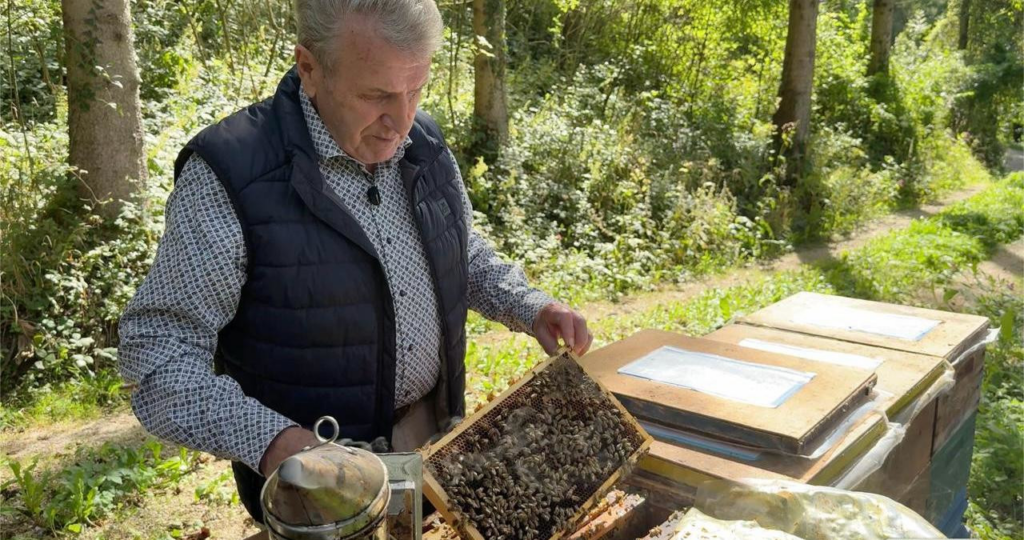
By IM Alois Wallner, 3263 Randegg
in the journal BIENENWELT Article of Issue 1 January 2002
As a professional beekeeper with 700 bee colonies, I have had to deal with the parasite Varroa mite since 1985. I refer to myself as a student of our unfortunately so early deceased teacher Dr. Josef Bretschko. It was not until 1988 as a Dr. Bretschko also recommended other means of demilding as antic acid, I began my independent path of demiling: “readouting and breeding on natural varroa defense.”
Residue-free beeswax
Since I have only ever used formic acid for the annually necessary demiplications, all of my beeswax is detectable residue-free. In my opinion, residue-free beeswax is the basis for an objective and, above all, comparable selection to a measurable natural varroa defense of the individual bee colonies.
Review: In 1990 I published my book “Beekeeping Today” in my own publishing house (the book is out of print). In this book, I first introduced my method of selection to the killing of varroa mites by the bees. I had to accept a lot of criticism from the various scientists. Even for April Fool's jokes, my work was abused. In the meantime, however, the waves have smoothed out.
My reading for the property “Killing varroa mites by the bees”: This measured value is collected by five days in September daily at the peoples provided for here. With a magnifying glass (20 times magnification), the individual mites are examined for injuries (usually injuries to the legs of the mites).
Example: Total mite waste of a people in five days.
Total mite waste: 50 mites
of which 25 mites with injuries result in a varroakiller factor of 50 percent.
That is, half of the natural mite waste comes from a killing by the bees, the remaining mites without injuries could reproduce until natural death.
The more mites are killed in relation to the total waste, the more favorable I rate this property!
Through a painstaking selection and breeding, I was able to significantly increase this property in 13 years.
Below are the results in the year-on-year comparison
Varroakiller factor of breeding peoples from 1990 to 2008
| 1990 | ø 27 % |
| 1993 | ø 52 % |
| 1995 | ø 75 % |
| 1996 | ø 84 % |
| 1997 | ø 84 % |
| 1998 | ø 89 % |
| 1999 | ø 89 % |
| 2000 | ø 90 % |
| 2001 | ø 90 % |
| 2002 | ø 92 % |
| 2003 | ø 92 % |
| 2004 | ø 92 % |
| 2005 | ø 93 % |
| 2006 | ø 95 % |
| 2007 | ø 96 % |
| 2008 | ø 96 % |

How does this altered natural varroa defense affect?
With an average value of 80% varroakiller factor and more, I can do without the obligatory cutting out of the drone brood, the offshoots do not have to be demited immediately after their formation. I can now also do without the previously absolutely necessary residual mitigation in September. Only in support of the largest varroa pressure, so before the departure of the summer bees, I use twice formic acid. The bees do the residual mitigation themselves. All year round and around the clock, mites are killed by the bees. A demilding in the spring is therefore unnecessary. The Varroa mite has thus lost its terror in my beekeeping. Residue-free bee products, which also comply with the organic standard, can be marketed. With nature and not against it, my motto is.
Made in Austria
In the meantime, the method of measurability of the property “Killing of varroa mites” developed exclusively by me became part of the breeding guidelines of the German Beekeeping Association.
Summary:
Reading and breeding on natural Varroa defense is a difficult, decades-long work – this work cannot be asked of a simple beekeeper. The improvement of the natural Varroa defense has had a very positive effect in my professional beekeeping. Instead of four demitties, as usual in the past, two are enough today. The cutting out of the drone brood for varroa reduction can be completely dispensed with. In the past, I had to demilate the newly formed branches immediately, which has also become unnecessary. I used to have to perform a residual mitigation in September, which is also unnecessary, the bees take the residual mite themselves by killing mites all year round. A demilding in spring is also no longer necessary. The loss of peoples over winter is no higher in recent years than before the varroa invasion. In the previous year, the winter losses were one percent. Breeding for natural varroa defense was not a utopia in my beekeeping.
A look into the future?
When could 99% VKF be reached? This could possibly be calculated mathematically. Kindly, a well-known mathematician of our family has agreed to clarify this question.
Now the result of his calculation, based on the data from 1990-2006:
“Based on the development data since 1990, it is clear that an asymptotic approach to optimal resistance is seen. Time series analytical methods suggest an exponentially subdued growth of this key figure. On the specific data, this results in a reaching of the target value of 99 % varroakiller factor in 2011 (as of the end of 2006).’
The new selection:
I first collected measured values about the speed in the interception and killing of varroa mites of the latest breeding combinations in 2009. Whether or how much this new selection will be passed on, the measured values are not available until autumn 2010.